Sunday, April 16, 2023

Ten Men, $1 Trillion, and the Personalization of American Capitalism

 Capitalism has always been about the accumulation and the concentration of wealth. 
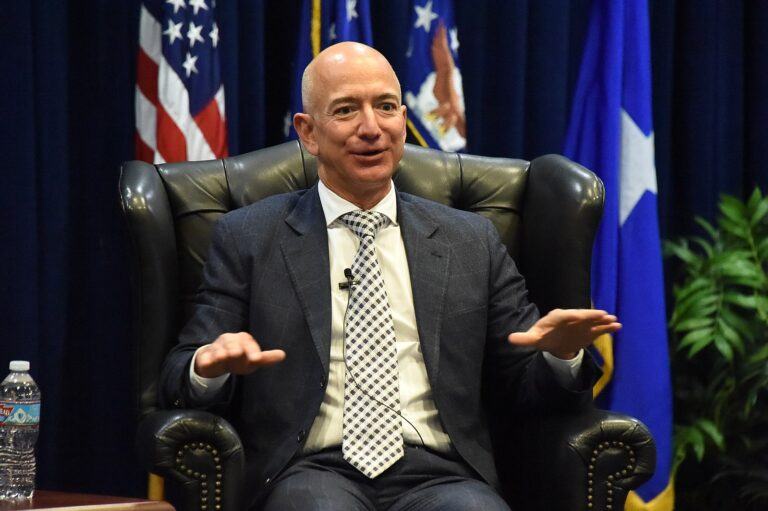


 Marx and Engels first described that phenomena in their 1848 Communist Manifesto Thomas Piketty has also reminded us of that.  But what they never focused on was the personalization of wealth in capitalism and what that means for society.  The latest rankings of the richest individuals in America reminds us of the persistence and personalization of wealth.

Forbes just released its ranking of the richest individuals in the world.  Topping the list is Frenchman Bernard Arnault of LVHM, the fashion and cosmetics empire, with a net wealth of $211 billion.  Yet if we focus simply the  ten wealthiest in the world, seven of them are located in the US, with a combined wealth of $786 billion.  The ten richest Americans, including the likes of Elon Musk, Jeff Bezos,  Larry Ellison, and Michael  Bloomberg total $1 trillion dollars.  And this list does not even include the Waltons who own the Walmart empire or the  Koch family.  Of the twenty-five richest individuals in the world seventeen are American.

For some this is God Bless America!  It is the story of the American dream where any of us can become billionaires, or if all else fails, at least millionaires.  Yes while the US has the greatest number of billionaires in the world and perhaps the greatest density of billionaires per capita, it’s Gini coefficient, which measures economic inequality on a scale of 0 (totally equality) to 100 (extreme inequality), has fallen from  039 in 1970  to 0.43 in 1990 to 0.49 in 2022.

While the US was never an economically egalitarian nation, at least in recent history, it has fallen to become one of the least equal among any countries in the world that likes to consider themselves democracies.  Combine this with the decline in social mobility in the US that is getting progressively worse by generation, and it is hard to conclude that the American Dream does exist except for a few.

Capitalism has always been personalized, especially in the US.  It was once the story of the Vanderbilts, Duponts, Carnegies, and the Rockefellers who made money in railroads, finance, or oil.   They made billions at the expense of the workers whom they exploit, and then we lionize them as heroes and beg for their money when they created charitable trusts or foundations. We view them as benevolent and generous, forgetting how they made their money.  They were literally the faces of nineteenth and twentieth century American capitalism.

Today’s personification is Silicon Valley, social media, and tech.  In addition to Musk, Bezos, Ellison, and Bloomberg, it is also Bill Gates, Mark Zuckerburg, Larry Page, and Steve Ballmer.  It is still an American plutocracy, except the nature of the capitalist wealth and their faces have changed.

But we should not forget the other faces of American capitalism  These are the faces that John Steinbeck talked of in his Grapes of Wrath to Michael Harington’s The Other America to Barbara Ehrenreich’s Nickel and Dimed to apropos Faces of Povertythe documentary.  We have nearly thirty-eight million people officially in poverty, each a story of how the American dream is merely a dream for them.

It is no coincidence that there is a connection between poverty and billionaires.  The more that a fewer and fewer number of individuals are rich the greater the number of individuals who will be poor.  Compare the $1 trillion in wealth for ten Americans to the fact that the bottom fifty percent of Americans—roughly 165  million individuals—have a combined wealth of $4.1 trillion.  If your net worth is between $43,760 and $201,800, you are in the middle class.  Once you get below the middle class, there is no net worth—individuals are in the hole and owe more than they own.

Donald Trump and January 6, made many question the viability of American democracy.  Perhaps its viability should have been questioned even before that.  The problem with billionaires is not only that they are different from the rest of us—to paraphrase from F. Scott Fitzgerald—because they are rich, but also because they are using their economic power politically to keep themselves rich.

This essay originally appeared in Counterpunch.

What will fix St. Paul’s failing infrastructure?

This blog appeared originally in Minnpost with John Mannillo. 


April 10, 2023

As winter ends St. Paul residents yet again experienced badly plowed streets and now miles of potholes that need not just patching but complete reconstruction. The City of St. Paul wants permission from the state and its voters to increase the existing sales tax of ½% to cover the costs of road maintenance.


While the city does need additional revenue to perform basic city services such as road maintenance, the sales tax increase is literally patching over a bigger problem for the city – how to increase its tax base.


The roots of the dilapidated streets has many causes.


One, for years road repair was at best only patching. The city stripped off the surface asphalt without reconstructing the base, the latter often is the original and worn-out brick or cobblestone. Such quick fixes are short term cheap, long term expensive.


Two, for years St. Paul has failed to prioritize basic city services in the budgeting and staffing allocation. This is especially true with streets.


But perhaps the most important reason is simple – the City of St. Paul is broke. It just does not have the money to fund road maintenance, at least under the way it currently operates. Thus the request for the increased sales tax. However, the proposed increase will not provide enough new funding to cover even the stated needs, no less sustain many other new and existing ones.


The solution to the city’s street and ultimately financial woes must lie in increasing its tax base. It cannot rely upon the state for more local government aid. Partisan disagreement and outstate legislators who do not feel an obligation to support the cities, especially when they see obvious mismanagement are reasons for this.


Sales tax increases are not an option. They are regressive upon the poor and especially in a city such as St. Paul which is not a major tourist center, they will fall more heavily upon residents who are already overtaxed.


Other user fees are not reliable and individuals can avoid them. For example, according to the Bike Coalition, 5% of the population are regular bike riders. If this amenity is paid from property taxes, 95% of the people who never use a bikeway will have to pay for it. This isn’t fair to most people. Automobile owners pay for license and registration fees, and gas tax. These funds are paid by automobile owners’ for the use, construction and maintenance of roads. Shouldn’t bike users pay fees to cover all the expenses for their particular use of bikeways? Bike riders have been able to shirk their responsibility to pay for an amenity few of us use.


Again, the solution is not raising taxes but expanding the overall tax base.


The root of the problem goes back to when Norm Coleman was mayor. He convinced the city to use tax increment financing (TIF) to fund development and St. Paul continues to rely on it to this day.


TIF operates by giving developers property and other tax breaks to developers for many years. In theory, the development is tax exempt but in practice is supposed to be captured by St. Paul in order to finance the tax break. It is sort of like supply-side economics for developers with the false belief that if we cut taxes for them everyone benefits.


The problem with TIF is that property taxes – which pay for city, school, and county services – are twofold. One, it takes away revenue to pay for the services for St. Paul, its schools, and the county. Two, overused as in St. Paul, it exempts more and more property from taxes, thereby failing to achieve its objective of promoting economic growth and an expansion of the tax base. St. Paul’s tax base, already challenged by the number of tax-exempted government and non-profit properties in the city, exacerbates its problem by giving developers TIF handouts that they do not need.


Since 1995, St. Paul has increasingly granted TIF to developers as an incentive to build in its city. This has been so abused to the point that without TIF expenses (debt service and reduced property valuations) St. Paul could more than cover all the needs of road repair and the Parks Department. The business community has always welcomed this subsidy, as well as most elected officials who see a benefit from new development, often before elections.


St. Paul has numbers approaching 60 TIF districts (not only just individual buildings). The legal requirement is that a TIF grant can be awarded to any development that will solve a situation of blight, and that the project would not proceed “but for” TIF. This has totally been ignored in St. Paul. Developers, when asked if they would develop without TIF, the answer of course has always been “No.” Property taxes for all these developments, for at least 25 year terms are granted back to developers. This results in a shifting of property taxes to other businesses and homeowners.


It doesn’t end there. Any developer interested in St. Paul, must compete with a myriad of competition from other TIF subsidized properties. Too often TIF is the easy answer. The theory is TIF will attract additional development that will provide new taxes. But new development in these districts also qualify for TIF and again do not increase any tax base. We have used up our most attractive commercial real estate for development that doesn’t generate taxes. Instead, it increases our tax burden these developments require for services.


Incentive to build new commercial projects in St. Paul, where there isn’t adequate demand, depletes overall commercial occupancy in the city. Rental rates are forced down. Property valuation on commercial property is determined from net operating income. When this is reduced, so is our tax base. This is the opposite result of what we were told TIF would do.


Now, the national impact of a 39% average commercial vacancy in downtowns after the pandemic will impact our tax base even more. The taxpayers will have to cover much of the debt service for those projects with general obligation bonds and without assessment agreements that guarantee shortfalls in required tax receipts to pay TIF debt.

So, in order to recover, we first need to stop the financial bleeding. This TIF addiction continues today. A sales tax increase does not solve the problem. A new strategy to expand the tax base is really what St. Paul needs to do.

Monday, April 3, 2023

Dog the Wag: Trump, Indictments, and the Corporate Media


            Wag the Dog was a 1997 film depicting a presidential candidate seeking to cover up a sex scandal by starting a fictitious war to distract the corporate media and the American public.


            Now we have the corporate media and the American public obsessed with a presidential sex scandal that diverts our attention from  war in Ukraine and other more pressing issues.  We are dogging the wag at the benefit of Donald Trump.

            The American media is obsessed with Donald Trump because he makes them money.  In 2016 he received $5 billion in free media time.   This earned media  contributed to his victory over Hilary Clinton who raised far more money than  Trump.  Throughout his presidency the corporate media, including CNN, MSNBC, and FOX,  earned billions off of Trump.  He started the morning off with one or two Tweets, driving the daily coverage for the press which slavishly reported on everything he did or said. The more outrageous the better.

            It did not matter if he lied or not. Or whether he made sexist or racist comments.  Trump and the media were in a symbiotic relationship.  He needed them as a politainer (politician + entertainer) to get the attention he needed, and they needed him for copy, clicks, and profits.  They could not stop covering him, no matter what.  This is, as I have argued. American politics in the age of Trump.

            Never mind that the Trump tax cuts  made wealthier people like  him richer and hurt his base.  Never mind that he sought to gut much of the regulatory state.  Never mind that he packed the Supreme and lower federal courts.  Covering these matters were sideshows for the media, and Trump know how to make them a sideshow by driving the media agenda.

            Nothing has changed in Trump’s post-presidency.  Every comment, every stop, everything that Trump does gets covered.  And now we have a replay of a sex scandal.

            Trump allegedly paid off a porn star seven years ago to silence  her during his first presidential run.  Now its back in the news as Trump has become the first (ex-)president  to be indicted for a crime.  Starting over  two weeks ago when Trump announced he was about to be arrested the media is apoplectic over this.  Pundits, politicos, and political analysts are having a field day attesting to the merits of the charges—even though we have no idea what they actually are yet.  It’s as bad as ESPN pre-game speculation.

            The 2024 presidential election cycle script is already written for Trump.  The media will cover this indictment and perhaps others too, but the juiciness of this one involving sex and payoffs will no doubt dominate.  Trump gets the media moment he wants, reinforcing his grip on the Republican base and generating millions of political donations he will use for his legal defense.  He gets the coverage he wants, the media gets the viewers they want.

This is dog the wag.

Sunday, April 2, 2023

The Magic Asterisk * Minnesota State Budget


       What if the State of Minnesota spent money when it did not have a plan for how to pay for it?  This is essentially what Minnesota is doing now–budgeting with a promise or a floating asterisk that spending today will pay for itself in the future.  This is the DFL version of Reaganomics from the 1980s all over again.


Asterisk One:  The Smoke and Mirrors of Reagan Supply Side Economics

            The Reagan tax cuts were based on a fiction.  The fiction was supply side economics and the famous Laffer Curve.

            Arthur Laffer at a restaurant drew a curve on a napkin.   He argued that cutting taxes would eventually spur more investment and therefore the increased economic growth would pay for itself and therefore no cuts to social-welfare programs would be needed.

            In reality, this was a facade.  It a 1980 president debate when then candidate John Anderson was asked how Reagan could cut taxes and increase military spending while balancing the budget, he responded it was possible only with smoke and mirrors.  He was correct.

            Eventually Reagan, with Democratic Party complicity, did cut the top rate on taxes in America, with the affluent and corporations benefitting the most. David Stockman, his budget director, recognizing that the cuts would not pay for themselves, indicated in his proposed budget that there would be $44 billion is future cuts, marked by a “magic asterisk” in the budget.

            What eventually happened is that the US recession and tax cuts hemorrhaged the US budget, thereby becoming the cudgel to force additional cuts to social welfare programs.

            In effect supply side economics forced economic choices upon a future Congress and president, the implications of which we still face more than 40 years later.


Asterisk Two: The Minnesota Budget

            Minnesota has a $17.5 billion surplus.  The source of the revenue is both one-time federal money tied into Covid relief, the other is taxes. 

            Covid funding is ending and is not returning, especially with a divided Congress unlikely to expend more money and a Republican House looking to cut.  

            Future tax revenues are not guaranteed.   Fears of recession are about as the Federal Reserve raises interest rates to slow inflation and fears of future bank failures are chilling consumer confidence.   Moreover, Minnesota’s economy is performing more slowly than many other states.  Altogether, continued tax revenue along the path Minnesota has recently experienced is not guaranteed.

            Yet despite this the Minnesota DFL, who hold a trifecta in the state government, are prepared to spend all the surplus, and then some.  It is spending for many worthy causes, but the sustainability  of the spending is a problem.

            The spending of one-time money is not for one-time projects.  It is for structural commitments to education, housing, and many other needs.  By structural one means that these are not one time spending commitments coming from onetime money.  They are the down payment on multi-year spending and priorities.  After the surplus is spent in the next biennium budget and beyond there will be a need to fund these commitments.  And the current and proposed taxes may not be sufficient to cover the expenditures.

            I have taught economic development and budgeting. I am well versed in Keynesian demand side economics and how government spending can encourage economic growth.  But overused, over stimulus by government spending can be inflationary and lead to budget deficits.  Government spending does not always pay for itself, at least not in the short run.  And in the long run, as John Maynard Keynes once said, “We are all dead.”

            Perhaps the idea is that spending all this money now on popular programs will ensure a DFL re-election. Or perhaps the popularity of the spending will create a powerful constituency for these programs and therefore they cannot be cut.

Or perhaps this spending is the new floating asterisk.  We do not know where the money to pay for these commitments will come from, but we will mark the savings or benefits with a floating asterisk as a placeholder until we do figure it out.

Thursday, March 30, 2023

Guns, Statistics, and Social Science


Another day, another mass killing at a school.  This time Nashville. 

But unfortunately and predictably there will be another mass shooting. Predictably there will be the same polarized political debate that results in a policy stalemate. And predictably the debate around guns will center on the usual stereotypes and myths that continue to confront mass killings in America.


The NRA will trot out  that the problem is not too many guns or the type of guns but that there are not enough in the right hands.  It will join a US Supreme Court in contending that the Constitution protects our right to possess guns (especially handguns) in our homes and perhaps on the streets for self-defense. Progressives will demand new gun control legislation, calling for bans on assault weapons, purchase delays, and background checks.  Across these debates facts take a backseat to myths.


Social science research can both inform and muddle the debate on  guns in America and reinforce and dispel the myths or pop culture views informing what our policy responses and options should be.  Let’s use good research here.  What do we know?


The Problem of Mass Killings

            Mass millings such as what happened in Louisville are tragic.  But mass shootings pale in comparison to other forms of gun violence.

            Mother Jones maintains a database on mass killings, defined as four or more individuals killed in a public place. They began assembling the database in 1982 and updated to Louisville.  During that 41-year period there have been 1101 killed, another 1885 wounded.  Of the 141 incidents, 22 are school-related.  Sixty-six of the assailants had some history of mental  illness.  Finally 99 of the incidents involved weapons labeled as semiautomatic and seven as assault.


Gun Deaths in America

            Let’s do  some comparisons.

            According the Center for Disease Control, in 2020, there were 24,292 suicides that involved guns.  In one year there were 22 times more suicides with guns compared to mass killings in America in 41 years.

            Alternatively, the  Gun Violence Archive focus on four or more shootings, even if no one dies.  Since 2013 they calculate 144 mass shootings with total dead and wounded as 7,740.    One year of gun-related suicides is still  more than 3.1 times the number of mass shooting injuries in ten-year period. 

            Handguns are the gun of choice for 69% for males and 88% of time for females when committing suicide.   In crimes, among the approximately 19,400 homicides in America in 2020, about 57% were probably with handguns.  Simply put, of the 45,222 gun deaths in America in 2020, less than one-percent were mass shootings that took place with assault-type or semi-automatic weapons.

            Finally, there is little evidence that guns are used for self-defense and instead are more likely to be  used  against another member of a household or for suicide that to thwart an intruder.

            All gun violence is bad, but mass shootings with  assault guns pale in comparison to  hand gun suicides and other forms of homicide. If we really wanted to affect gun violence in America we would be better served targeting resources on handguns and addressing the issues of suicide and the reasons why people kill in general. 


The Myth of the Mentally Ill

            The Mother Jones database alone should dispel the mentally-ill bias.  Sixty-six  of the approximately 141 shooters had a history of mental illness, 17 did not, the remainder is indeterminate.  Given these statistics, there is nonetheless a belief that mental illness is connected to mass shootings.  Yes, that is partially true, but this does not provide a complete picture of the connection between mental illness and gun violence.


Based on mass shooter research, there is a profile that such individuals are mentally ill and therefore we need to screen for this when it comes to access to guns.  Additionally,  in seeking to craft a profile of a mass shooter, studies seek to look at other variables, such as perhaps childhood trauma, unstable family structure, stress, or neighborhood characteristics.  There are problems in making these claims.


The first is a problem of reverse engineering.  By that, we do case studies of mass shooters and create a profile of who they are.  The goal here is to develop a screen and identify possible future shooters.


Reverse engineering here is dangerous.  What counts as trauma or unstable family structure, for example, is not well defined.  With that, moving from saying all mass shooters had X traits runs the same risks of stereotyping as do other forms of profiling. Profiling originated in efforts to predict who would hijack airplanes in the 1970s to eventually racially profiling and auto stops in the 1990s and then Muslim profiling after  9/11.


Not everyone who has a mental illness is violent or dangerous.  The National Institute of Health estimates that in 2021 57.8 million adults in the US have some form of a mental illness.  At most, only a small fraction are violent.   The American Psychological Association notes that if a person has a mental illness there may be other risk factors that are associated with violence, but mental illness alone is a poor predictor of violence.  Of those with a severe mental illness, 2.9% had committed a previous act of violence within the past four years compared to 0.8% for the general population.  Note the emphasis on severe mental illness, not all forms of mental illness.  For all individuals with all forms of mental health issues, barely one-percent are violent—about the same rate as the general population.


Moreover,  a better risk factor tied into violence, according to the APA, is substance abuse.   The Center for Disease Control lists many factors that lead to violent behavior, including substance abuse, emotional problems, family, and neighborhood factors. But here is the problem, not everyone who had childhood trauma, grew up in bad neighborhoods, or faces stress is violent and becomes a mass shooter.    In fact, the vast majority  of these individuals do  not exhibit this behavior.


Using case studies with small samples to determine the profile of mass shooters and then making that a predictive tool to inform public policy is highly problematic.  It is not the  problem of the ecological fallacy—extrapolating general population characteristics to make claims about individuals—but instead the atomistic fallacy of making incorrect assumptions about a population based on the traits of some individuals.  This is an inductive problem of rendering false generalizations.  It is also the classic mistake of confusing correlation with causation.  Mental illness may appear to correlate with mass shooters, but bad sampling and faulty  assumptions  render bad social science and predictions. It is using anecdotal and low number case studies to render broader conclusions.


Conclusion

            There are several conclusions.  Mass shootings are a problem but relatively insignificant in terms of gun violence.  Handguns are a far bigger problem than assault weapons.  Using mental illness as a predictor of  gun violence or mass shooter profiles is under and over-inclusive of who commits such violence, and the same may be said of other forms of profiling.  At best we may have some factors that are associated with gun violence, but using them as a predictive screen is at best porous.


Contrary to Second Amendment defenders, we probably need to address the issue of handgun availability because simply relying on profiles will not address overall gun violence in America.  And contrary to those who focus on assault weapons in mass killings, this fails to capture the broader and more significant problem of gun violence in America  and who commits it.

Tuesday, March 14, 2023

Improving Minnesota education: What does the evidence say really works?

 This blog originally appeared in the Minnesota Reformer.

Minnesota  has a racial disparities problem. This includes education.


Minnesota Department of Education statistics point to Black and other students of color scoring 30 points or more lower on achievement tests compared to whites.  In 2019 the U.S. Department of Education ranked Minnesota the worst in the nation for racial disparities.  In 2022 WalletHub placed the state second worst in terms of racial equality in education.

Even beyond race, the quality of Minnesota schools is slipping as measured by national standards.

But with the DFL having trifecta control of the House, Senate and the governor’s office, and a $17.5 billion surplus, they vow to “fully fund” education.  This funding aims to pay for special education, free food for students, smaller class sizes and better pay for teachers.

While these proposals are laudable, they raise two questions:

  1. What impact will all this new spending have on the quality of schools and educating students?
  2.  How will this spending address the racial disparities gap?

So far little has been said in terms of how these issues will be addressed by new spending. Assume for the sake of argument Minnesota is serious and wants to improve student performance and mitigate the disparities gap. What actually works?  What does the evidence show in terms of what can be done to improve education?

There are a wealth of micro factors that impact student learning — such as good curriculum and classroom management — but what types of macro or structural factors impact student learning?  If one has a finite amount of dollars, what is the best way to spend it?  What impacts learning the best?

More money spent on education does improve outcomes. But the money has to be spent correctly. View spending as an opportunity cost or cost-benefit issue. In other words, what type of spending yields the best results in comparison to other expenditures.

First,  teachers probably deserve to be paid more. There are only modest increases in student performances that are associated with increased pay for teachers. Beyond a bachelor's degree, there is also only modest evidence that increasing teachers' credentials improves learning outcomes. Good teaching that excites or stimulates students promotes learning.

Smaller class sizes have some impact on learning, but only in some cases — perhaps grade school — but again the impact is modest compared to other reforms.

Apple has spent a fortune convincing people that spending on technology improves learning, but the evidence fails to show it. Technology, if it makes learning fun, might foster performance, but in itself it does not improve student achievement. For eight years I was editor-in-chief of a teaching and learning journal and never was there a credible article submitted to me that proved more tech toys improved learning.

Beyond ensuring that children are well-fed and not hungry, providing free meals to  students facilitates leaning. For a generation of us who grew up hearing that it is hard to learn when your stomach is empty, the evidence supports that. Additionally, gun violence, especially at schools, impacts student achievement.

But the biggest impacts on student performance have little to do with what happens in the classroom.

First, contrary to claims by many Republicans (though not only Republicans), there is little evidence that school vouchers or charter schools are cost effective ways to improve student performance. In fact, charter schools may also exacerbate segregation, which leads to greater racial learning disparities.

There is little evidence that single-parent households are associated with student achievement.  However, parental involvement, especially in terms of supporting teachers and encouraging their child to learn, positively impacts student achievement.

Increasing learning time is correlated with student learning.  The same is true for year-round schooling, which especially benefits those from low-income families.

What really impacts learning and racial disparities, however, is poverty, especially segregated schools and housing.

Minnesota has a long history of residential segregation which impacts schooling and learning. Overwhelmingly student achievement is correlated with poverty. Children who live in high or concentrated poverty neighborhoods generally do worse in school than those who do not live in them.

Students who come from segregated neighborhoods generally also do worse. Targeting funding to low-income school districts and addressing the disparities in funding between them and better funded districts overall improves student outcomes and addresses education racial disparities perhaps better than any other policy.

What do we learn from all these studies?  If Minnesota really wishes to improve educational quality, it first needs to address the way we fund and structure our schools. We should not fund them based on local property taxes but instead equalize funding across the state.

We should  also consider longer school days, year-round school, and remediating residential segregation. Providing free meals and  addressing school violence can help. We also  need to do more to facilitate family support for their children.

When I took my first teacher’s education class, the professor drew a triangle on the board and labeled the three corners family, community, and education.  The professor said that it takes all three to educate. He was correct. The factors that impact student achievement go well beyond what happens in schools.

Merely spending more money does not improve student achievement. We need to directly address poverty as well as how economic and racial segregation impact student performance.

Unfortunately, none of the proposals that I know of being offered by the DFL or the Republicans do that. In fact, many of the things we are doing, such as charter schools, only make matters worse. To really reform education in Minnesota means going after the way we fund  and organize schools and how money is spent.

Neither party, it seems, is willing to risk alienating suburban voters to do that.

Thursday, March 2, 2023

Should the Minnesota DFL fear the electoral reaper? Probably not

 My latest blog is from Minnpost Community Voices, March 2, 2023.


Should the Minnesota DFL fear the electoral reaper? Probably not

Trends suggest that unless the Republicans change their policy positions they are unlikely to be an electoral recipient of voter backlash of DFL policies in 2024 or in the near future.

By David Schultz

The Minnesota DFL has a state government trifecta with control of both legislative chambers and the governorship for the first time in a decade. They are moving one of the most progressive agendas in the nation. Some contend they are overreaching and will pay the political price come 2024. Is that true? The numbers suggest no.

Minnesota is one of 39 states with a one-party legislative trifecta. Of those, 22 are Republican and 17 are Democrat. Across these 39 states, single party control means winner-take-all politics where because of pronounced political polarization, the governing party moves its agenda without real support from the other party.

Minnesota is one of those states. In just a few weeks the DFL has codified abortion rights, adopted anti-discrimination legislation, adopted renewable energy legislation, granted ex-felons voting rights and permitted undocumented individuals to secure driver’s licenses. And we have not even gotten to how they plan on spending the $18 billion surplus on not simply one time programs (of which much of the money represents), but on structural items such as education and rent subsidies that have long term fiscal commitments. “Go big and then go home” seems to be the motto.

Yet some argue the DFL is overreaching.

Their abortion bill goes beyond what Minnesota public opinion seems to support according to critics. Licenses for the undocumented goes too far, and perhaps legalization of recreational marijuana is not a high priority for  suburbanites who want the DFL to address crime and public safety  issues. These bills along with others portend overreach with voter pushback in 2024.

But don’t count on the backlash. It may never happen.

Whether the DFL agenda makes good public policy is not the subject of this commentary. What is the subject is whether the Minnesota Republicans pose a viable challenge to the DFL in 2024 in the nine or so suburban House seats that will determine control of that chamber.

Consider first that the DFL may simply say that moving and securing their agenda while they have the chance is a once in a generation opportunity.  What they are moving in many cases is structural legislation that will be hard to undo in the future. Once many of these laws are in place there is no real viable way to unwind them. Moreover, the DFL is responding to their constituents and if elections mean anything it is translating voter preferences into public policy.

Additionally, only the House is up for election in 2024. Barring unforeseen circumstances, the DFL will still hold the Senate and governorship until 2026 even if they lose the House. There is no serious chance of repeal in the near future. Moreover it will be a presidential election year where turnout will favor Democrats. If Trump were to get the party nomination again – a real possibility – he will hurt the Republican chances to pick up crucial suburban seats where he is very unpopular.

Plus, the Republicans have a problem longer term. They have failed to win statewide office since 2006 and have not won the presidency in Minnesota since 1972. The state GOP party is in disarray and seems to have financial difficulties. The Republican poor showing in the state is reducing the probability that national money will flow to Minnesota, which is looking less and less like a swing state and more like California.

And while a lot can change, the Republicans neither have a farm team from which to recruit a viable statewide candidate in the near future (which Republican has any hope of beating Sen. Amy Klobuchar in 2024?) nor do they have policy positions that seem to resonate with majorities of the Minnesotans. For example, part of the reason the DFL moved its abortion legislation is that Republicans, including  Scott Jensen and Rep. Michelle Fischbach, 7th District, wanted to ban it. They and Republicans were never willing to compromise on the issue and paid the price. The same can be said on guns and perhaps other items.

But perhaps the most important reason why the DFL don’t fear the electoral reaper is demographics. Demographics are not destiny and the DFL will be sadly mistaken if they think it is. Candidates, messages, and strategy still matter.

While in 2022, 2020, 2018 (excluding Klobuchar), and 2016 the DFL won only 12, 13, 20, and nine counties, it is winning the counties that matter. Five counties in 2022, Dakota, Hennepin, Olmsted, Ramsey and Washington account for nearly 46% of the registered votes and 46.5% of the actual voters. While nearly 70% of those registered to vote cast ballots in the big five counties and in the rest of the state, Democrats are winning these five by an average margin of more than 25%.

Moreover, nationally and in Minnesota rural or non-metro voters cast their ballots for Republicans, with white working class being the core base for that party. While short term Minnesota’s rural counties are growing because of the pandemic and perhaps urban crime, longer term they face a severe population declineNationally, white working class are in decline as the nation diversifies, and the same is true in Minnesota. With reapportionment over time, fewer and fewer seats will go to Republican-leaning areas, reducing even the GOP’s regional voice and influence.

The Republican base is literally dying off.  It is gradually being replaced with voters more likely to support the agenda and issues the DFL is supporting. Perhaps they do not endorse it as far reaching as the DFL is pushing the policy agenda right now. But trends suggest that unless the Republicans change their policy positions they are unlikely to be an electoral recipient of voter backlash in 2024 or in the near future.