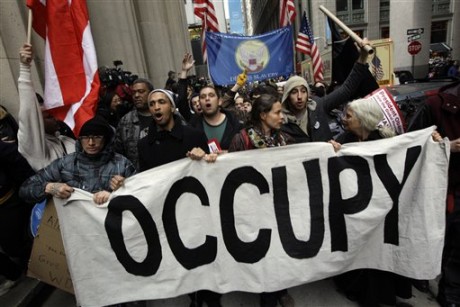
 Occupy Wall Street (OWS) is a cacophony of voices speaking a simple message about the structural economic and political inequalities in America and around the world. Sharing affinities to the 1999 World Trade Organization protests against globalization, OWS looks to the growing power of global financial institutions and their stranglehold on governments around the world.
OWS points to how the Bush and the Obama administrations loaned or credited trillions to banks and the too-big-to-fails to bail them out after they gambled on Wall Street, only to see homeowners face record losses in their houses and illegal foreclosures by these institutions. Tax breaks and loans were provided to the big auto companies but little was done to help the unemployed. The banks of Europe were recapitalized by the International Monetary Fund and the European Central Bank, but Greece and Italy was compelled to take the so-called "haircuts." Democracy has taken a backseat to saving capitalism. This is the message of OWS.
While Rome and the rest of the world burn, Nero fiddles. At least in this case, the fiddling is done by the Republican presidential candidates, who assert that all that ails the economy can be cured by more tax cuts and free markets. But while the GOP fiddles, a host of interesting studies have come out documenting and criticizing the ideology of Herman Cain, Michele Bachmann and company, as well as offering some insights into the state of the American economy. These reports are worth noting since they have received scant notice in the mainstream media.
The rich are getting richer, the poor poorer, no matter how you examine it.
In October a Congressional Budget Office report documented the growth in income in the United States from 1979 to 2007. For those in the top 1 percent bracket, their income increased by 275 percent. For those in the top 20 percent, it increased by 65 percent, for the middle incomes it was a 40 percent increase, and for those in the bottom 20 percent it was scant 18 percent. In 2010, the census reported the richest 5 percent of the population accounted for 21 percent of the income, with the top 20 percent receiving over 50 percent of the total income in the country.
Moreover, the latest census figures point to a poverty rate in 2010 of 15.1 percent, representing a record 46 million people in poverty. But earlier this month the US Census Bureau issued a new report recalculating what constitutes poverty — noting that current estimates are based on an outdated methodology from 1960s. This measure for calculating poverty did not include government transfers (welfare) or tax cuts when making estimates, and it also did not reflect the current spending patterns of Americans. Using new measurement tools, which the Census Bureau calls the "supplemental measure of poverty," the study concluded that the poverty rate is actually 16 percent — higher than the old estimate — constituting more than 49 million individuals in poverty. So much for welfare queens getting rich on the system.
The rich and poor live in separate worlds.
There is a geographic basis to poverty. Generally the assumption is that poverty is concentrated to the urban cores of major cities. One way to measure the spatial dimension to poverty is to use census data. Census tracts where 25 percent or more of the households live in poverty are referred to as high-poverty neighborhoods, and those with 40 percent or more of the households in poverty are referred to as extreme-poverty neighborhoods. Concentrated poverty is a problem because of the issues surrounding low economic opportunity, high government social service costs, and crime.
Looking at concentrated poverty across the United States, the Brookings Institution recently concluded that 10.5 percent of all individuals lived in extreme-poverty neighborhoods, up from 9.1 percent in 2000. Estimates are that more than 15 percent overall live in concentrated-poverty neighborhoods, with the most rapid growth occurring in the suburbs. The Twin Cities metro region is not immune, with 9.4 percent of the population living in concentrated poverty neighborhoods that include some suburbs but mostly the Minneapolis-St Paul urban cores. These trends parallel 2000 census data demonstrating the gravitation of poverty from the cities to the inner ring suburbs, creating really a two-tiered metro region marked by affluence and poverty.
Similarly, in the just released Stanford University/Russell Sage Foundation’s “Growth in the Residential Segregation of Families by Income, 1970-2009,” researchers found that America was becoming increasingly segregated by income. In 1970 only 15 percent of families were living in affluent or poor neighborhoods, but in 2007 it was 31 percent. They researchers also found that high-income households were less likely to be found in mixed-income neighborhoods than the rest of the population. In general the percentage of Americans dwelling in middle-income neighborhoods was dwindling and, in fact, these types of residential neighborhoods were shrinking.
Overall the study noted the increased economic and racial segregation in this country, with individuals of different classes less and less likely to come into contact with those from other social-economic backgrounds. America has become a tale of two cities.
Taxes really are not job killers.
The canned line from the Republican candidates has been this: high taxes are killing the economy and forcing companies out of business. Three reports again reject this contention.
The Bureau of Labor Statistics compiles data on reasons for mass layoffs. In its most recently survey, which covers 2010 and 2011, factors such as cancellation of a contract or order for goods, insufficient demand for products and increased automation account for the vast majority of layoffs. High taxes do not even appear on the list as a reason.
Second, the National Federation of Independent Business (NFIB) recently completed a survey asking small businesses to identify the single biggest problem they face. Taxes came in third, with poor sales listed as the biggest issue.
Third, the Citizens for Tax Justice recently released a report, “Corporate Taxpayers & Corporate Tax Dodgers,” documenting the biggest businesses that have failed to pay their fair share of taxes. Among the worst offenders, corporations such as GE, DuPont, Boeing, and Wells Fargo paid no income taxes from 2008-2010, let alone the theoretical 35 percent statutory corporate rate. The Citizens for Tax Justice report documents scores of blue-chip American companies that failed to pay any taxes during these three years, questioning the claim that high taxes are depressing employment and their economic growth.
Moreover, in addressing the arguments made by Herman Cain and others that high corporate tax rates discourage American companies from repatriating $1.2 trillion in money being held overseas, the Corporate Taxpayers study points out that corporate tax rates in other countries are often significantly higher. Additionally, if there is a tax advantage to off-shoring jobs it comes only because American law allows for a permanent deferral on foreign profits. The solution is simple: repeal the deferral and do not allow corporations to use the tax code as an incentive to out-source. Overall, the United States government is facilitating this problem by adopting policies that encourage evasion.
The message from all these studies point to a nation increasingly divided by income, region, and class. They point to a country where the rich pay little taxes or better yet, are able to use the tax code to their advantage — and to a world where in reality, unemployment and slow economic growth are not due to high taxes but to other factors.
Occupy Wall Street is about highlighting these facts, seeking to reintroduce the simple concept that capitalism is meant to facilitate democracy and not vice versa.

