Showing posts with label Pennsylvania. Show all posts

Tuesday, September 17, 2024

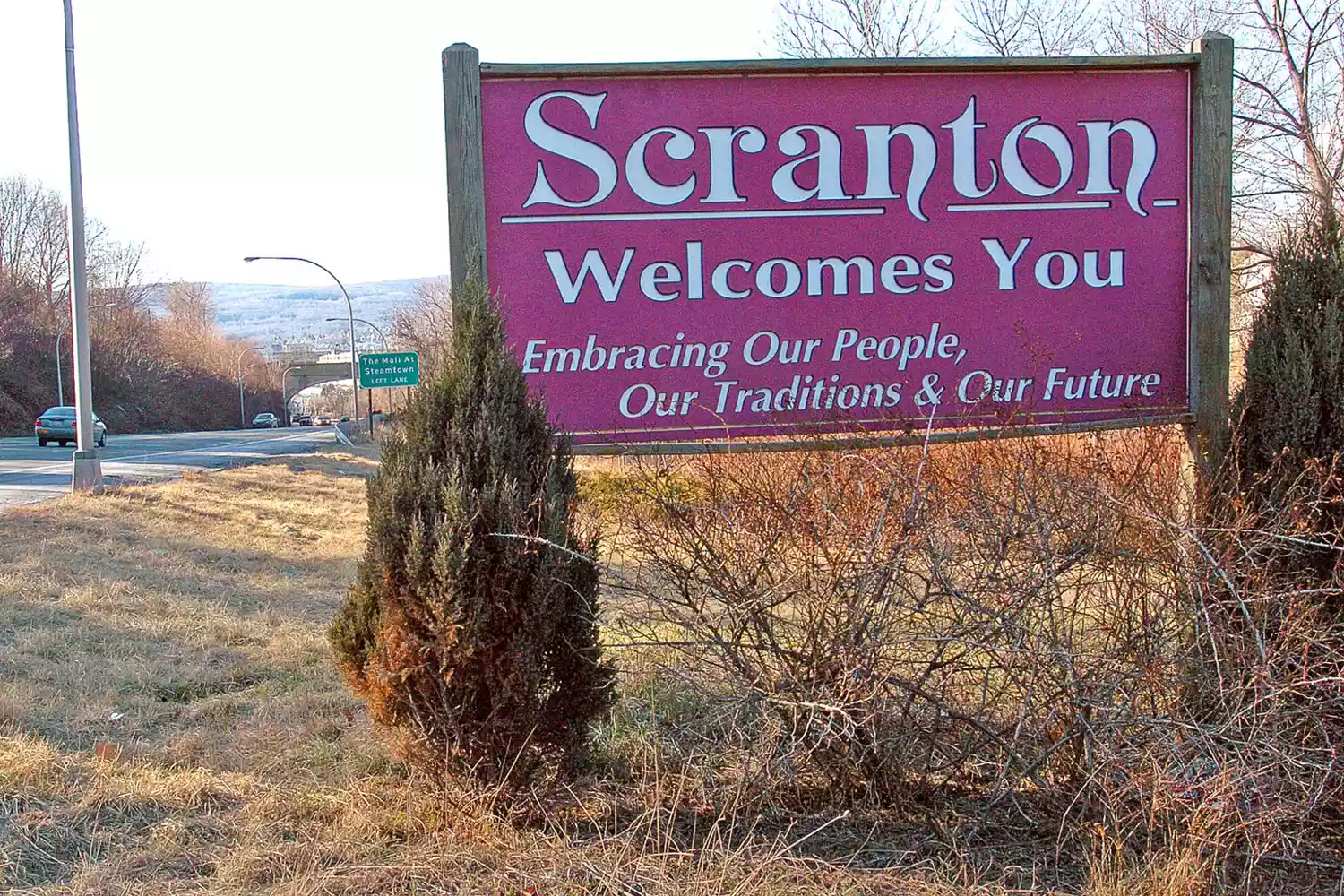
As Scranton goes, so goes the American presidential election yet again


In 2024 Lackawanna County will again be the decisive bellwether county that determines whether Donald Trump or Kamala Harris will be president.

The media and the presidential campaigns are focused this year on the six or seven swing states that will decide the presidential election. Donald Trump and Kamala Harris each have their respective safe states that will vote for them, but neither of them has wrapped up enough electoral votes to win the election.

 In the past Maine, Missouri, and Ohio have been the critical swing or bellwether states that decided presidential elections. Within those states powerful swing counties stood out. Whichever candidate won a county in that state would go on to win that state in the presidential election.

For years, Hamilton County, Ohio was the bellwether. Win Hamilton County, where Cincinnati is located, meant that one would win Ohio. Were one to win Ohio, one would win the presidency. But demographics and politics have changed. Lackawanna County has replaced Hamilton County as the most important battleground in the country.

Historically, Lackawanna County voted for Democrats for president. It was working class, union, and manufacturing. As late as 2012 Barack Obama won the county over Mitt Romney, 63%, to 36%. But then the economy changed. The factories closed down. Union jobs exited and mining ended. The political base of the Democratic Party eroded, and workers did not see them helping enough.

The Democratic party moved to the left on many social issues alienating those unemployed workers who used to vote for them. Today, Lackawanna County sits to the political right of where the Democrats are, and to the political left of where the Republicans are. It is a true swing county that is a bellwether of Pennsylvania and national politics.

Eight years ago, in August of 2016 I argued that Lackawanna County was key to that presidential election. If Trump were to win the county or to get close, he would go on to win Pennsylvania. Were he to win Pennsylvania, he would go on to win the presidency

In 2016 Hilary Clinton—whose family roots were in the county—won the county, but with barely 50% of the vote; down 13% from Obama's 2012 victory. Trump won 47% of the vote. He got close in Lackawanna County, went on to win Pennsylvania, and went on to win the presidency. All this as predicted.

Joe Biden, a native also of Scranton, in 2020 went on to win Lackawanna with 54% of the vote, while Trump dropped to a little over 45% of the vote. Biden then went on to win Pennsylvania, and eventually the presidency.

In 2024, it is not clear by how much Kamala Harris must win Lackawanna County to repeat the performance of Biden and avoid the loss by Clinton. She certainly needs to win decisively more than 50% and hope that Trump does not improve upon his 2020 numbers. It is doubtful that Tim Walz or JD Vance, two Midwesterners, resonate with undecided voters in Scranton.

Were I advising Harris or Trump, I would tell them to frame your issues and your campaign pitches in such a way to win over the disaffected, undecided voters in Scranton. In a polarized political America, they are at the center and torn between two parties that do not speak to them. The voters there will again this year decide who wins Pennsylvania and who wins the presidency.

Monday, October 9, 2023

If the US Presidential Election were Held Today (Or Why Democrats Should be Beyond Worried)


Polls are not predictors.  They are merely snapshots of public opinion at a specific time. A lot can


change between now and the November 2024 US presidential election. But if the election were held today Donald Trump would beat Joe Biden in the electoral college and perhaps in the popular vote.

            There are many indications that Joe Biden is in deep trouble.  National  polls right now place him and Donald Trump in a tie, or with Trump with a slight lead.  But ignore all national polls.  We do not elect presidents either by national polls or a national popular vote.  All that matters is the electoral college and the race to get 270 electoral votes.

            But as I have written, not all fifty states are created equal.  Because of partisan demographics, population sorting, and the fact that forty-eight out of fifty states allocate their electoral votes on a winner-take-all basis, only a few swing states matter.  Within those few swing states perhaps only a few swing voters matter.  Back in 2015, I argued that there were only three numbers that mattered—10/10/270.  Ten percent of the voters in ten states would determine who would become president.  The reality was three swing states—Michigan, Pennsylvania, and Michigan decided the election.  Within those three states, shift 90,000 votes and Hilary Clinton would have been president. 

Four years later, factoring swing counties into the equation, the equation was 10/10/7/270.  Ten percent of the voters located in perhaps ten counties across seven states would decide the election.   In 2020 the election came down to Arizona, Georgia, Michigan, Pennsylvania, and Wisconsin.  But had 43,000 more individuals voted for Trump in Arizona, Georgia, and Wisconsin, he would have won reelection.

Now four years later the numbers to look at may be 5/5/5/270.  Five percent of the voters in five counties located in five states—Arizona, Georgia, Michigan, Pennsylvania, and Wisconsin—will decide the election, with Maricopa, Fulton, Wayne,  Allegheny, and Door counties deciding who gets to 270.

How has the presidential race come down to this?

Let us assume that Joe Biden and Donald Trump are the presidential nominees in 2024.  Assume that that each of them wins all the same states they won in 2020, and that they again split the states of Maine and Nebraska the way they did in 2020.  Assume also that Arizona, Georgia, Michigan, Pennsylvania, and Wisconsin are the only swing states in 2024.  If the election were held today Trump would lead Biden in the electoral college 235 to 232.  This number reflects a shift in electoral votes after the 2020 census  that work to Trump’s benefit.  This leaves the above five swing states totally 71 undecided electoral votes.

Polls right now in  the five swing states show Biden leading in Michigan  and  Wisconsin (25 electoral votes) and Trump in the lead in Arizona, Georgia, and Pennsylvania (46 electoral votes). With the exception of Georgia where Trump according to the latest poll  has a nine point lead, all the margins  of victory are within the margin of error. This suggests that the races are really to close to call or could simply go either way.

Total up the safe states and swing states for each candidate.  Trump wins with 281 electoral votes to Biden’s 257.

The picture is bleak for Biden.  No sitting president has won re-election with approval ratings with what Biden now has.  Incumbents do badly when the public senses the country is moving in the wrong direction or when they perceive the economy is doing badly. This is the case now in the polls.

The public is worried about Biden’s age.  There is an enthusiasm gap comparing how Democrats feel about Biden compared to how Trump’s base feels about him.  Generally undecided voters break against the incumbent when they perceive things going badly in the country.

Add it all up—Biden is in serious trouble.

Biden and Democrats are hoping abortion saves them like in 2022. Or that the Trump legal problems and possible convictions will save them. These are tough bets to make.

Four years ago many viewed Biden as a one term transitional president who would pass the mantel on to a  new generation in 2024.  He still needs to do that.  There is a small window, perhaps just three to four months, that Biden has to decide to exit the race and leave room for another Democrat to emerge as the consensus candidate.

It is possible that Biden can still win. It is possible the polls are wrong or that they are not good predictors but simply snapshots in time.  One year is a political eternity.  Yet right now despite how bad a candidate Trump is with all his problems, there is no guarantee Biden  can win in 2024 and instead a good chance he will lose.

Monday, August 22, 2016

As Scranton Goes So Goes the Nation: or Why Nineteen Counties Will Decide the 2016 Presidential Race

Today's blog appeared originally in the Philadelphia Inquirer under the title of   As Scranton Goes So
Goes the Nation: or Why Nineteen Counties Will Decide the 2016 Presidential Race


It’s not simply a handful of swing states that will decide the 2016 presidential election.  The swing voters in the swing counties of the swing states will decide it.  And if my calculations are correct, it is perhaps no more than 19 counties in 11 states–less than 500,000 voters–who truly matter.  That’s why Scranton, Pennsylvania seems to be so important this year.
From 1988 to 2012 the balance of power in US presidential races has centered on ten states.  Republicans were likely to win 23 states totally 191 electoral votes and  the Democrats winning 18 states and the District of Columbia totally 232 electoral votes.  Then there are ten swing states–Colorado, Florida, Iowa, Nevada, New Hampshire, New Mexico, North Carolina, Ohio, Virginia, and Wisconsin–totaling 115 electoral votes.  As I described in  my Presidential Swing States: Why Ten Only Matter, these are the states where the presidential candidates campaign and visit after the conventions.  They are the bellwether states, the battleground states, they are those most likely to flip from one party to another, and the margin of election victory in each state is generally close, but with some, such as Florida and Ohio, even more decisive than others in terms of their presidential selection influence.
These are still the crucial swing states in the 2016 election.  Trump’s candidacy, both its strengths in appealing to white working class voters which may open up Pennsylvania  as a swing state, or its weaknesses such as its racial overtures in possibly making Utah and Georgia possible Democrat pickups, might change the electoral map slightly.  But the Electoral College and the way states allocate their electoral votes, along with the rise of political polarization and the declining number of swing voters to perhaps 5% of the electorate,  mean that even this year  in approximately 40 states the presidential race is largely already over.
But while pundits write about the swing states, more fascinating is how within them there are only a handful of counties that are decisive.  They are the swing counties where the candidates actually campaign and where if they can win them they win the state.   Since  1988 there have been a handful of swing counties.  In Colorado it is Jefferson County that is key to winning that state.   For  New Hampshire, it is Hillsborough County, North Carolina it is Wake County, Virginia it is Prince William.  In Florida it is Hillsborough, and in Ohio it is Hamilton County.   Win Hamilton you win Ohio, win Ohio you win the presidency.
In 2012 there were 15 counties in the ten swing states that were critical to Obama’s victory.  There were a total of 3,883,000 votes cast and Obama won 53.2%.  He out-polled Romney by less  than 350,000 votes.  It is not clear whether Romney could have persuaded them to switch and vote for him or whether he needed to mobilize other voters, but the reality is that across those 15 counties in ten states, a switch of 350,000 or so votes would now have Mitt Romney running for his second term.
Assume these are the same swing counties and states in 2016.   Perhaps now the number of swing voters in these states is up to 500,000 with population growths. Now add to that Pennsylvania, a state that has voted solidly for the Democratic presidential candidate since 1988.  Trump needs to flip it to win.  There are four counties in there–Bucks, Chester, Luzerne, and Lackawanna–that  may be key to the state.  Lackawanna County–where Scranton is located–seems to be the center of  Pennsylvania’s political universe this year.  Both Trump and Clinton have made recent visits there, expect more by November.  In 2012 almost 97,000 voted in Lackawanna Country with Obama winning nearly 63%.  Flipping that country seems like a tall order.  Yet these four counties had a total of 790,000 voters in 2012, and Obama won them with less than 52%–about a 26,000 spread.  Conceivably Trump could flip them but given that Obama won the state by more than 300,000 votes in 2012, Pennsylvania is a long shot.
Even with Pennsylvania thrown in, there are only about 19 swing counties in this year’s presidential contest that seem to matter.  The number of swing voters there may be less than 500,000.  The key to the 2016 election is moving these few swing voters in these swing counties in the swing states.  The rest of us should vote, but the reality is that the next president will be selected by these few voters in a few counties.


Sunday, November 4, 2012

The Day After the Election: Excuses


Come the day after the election there is a fantasy many of us have that the losing side  in the presidential race will tell the winning side that it was a hard fought and close campaign but that the winner won fair and square.  Unfortunately that will not occur, especially in light of all the pre-election litigation and legal posturing.

Assuming Obama wins, I suspect the argument Republicans make is that the election stolen.  Assume Obama wins close races in Wisconsin and Pennsylvania, Republicans claim that were it not for a court suspending or invalidating voter ID in those states Romney would have won.  Obama’s victory was a product of fraud.  In Ohio the message will be that the courts allowed too many provisional ballots and therefore fraud occurred, and in Florida they will argue that relaxation of some of the restrictions on voter registration and early voting will be the cause of ineligibles voting.  A few will also point to how mediocre a candidate Romney was, but the big issue will be fraud.

Conversely, on the slight chance that Romney wins, the cry will be that voter suppression across these states is the reason for the loss. A few will point to how mediocre a candidate Obama was, but the big issue will be voter suppression.

I am suspecting these talking points are already being cued up by members of this listserv and the two parties in anticipation of efforts to justify litigation, delegitimize the winner, and prepare us for the fact that on November 7, we will be less than two years away from the next elections.

Tocqueville got it right: “There is hardly a political question in the United States which does not sooner or later turn into a judicial one.  Consequently the language of everyday party-political controversy has to be borrowed from legal phraseology and conceptions.”

Tuesday, April 10, 2012

Etch-A-Sketch Time: The End of the Republican Primary and the Start of the General Election

It no longer appears if but when. Specifically, two questions now dominate the presidential race. First, when will Rick Santorum drop out. Second, when does the campaign shake the Etch-A-Sketch and switch into general election mode?

The End of the Road for Santorum

Math and the primary terrain are clearly against Santorum after he lost a hat trick last week in Wisconsin, Maryland, and the District of Columbia.  Romney has more than 57% (658) of the 1,144 delegates he needs to clinch the Republican Party presidential nomination. At this pace he merely needs to win about 45% of the remaining delegates–he can underperform slightly and still win. Conversely Santorum has won only 281 or 25% of the delegates and he would need to win 863 of the approximately 1,125 remaining delegates or 77% to clinch the nomination. Given that the primaries now turn to states such as California and New York, this will be tough. Both states are Romney ones in the sense of being more moderate and favoring candidates and SuperPacs with deep pockets.

The only two states that Santorum can hope for are Texas and Pennsylvania. Texas is a big southern state with evangelicals, thus it looks a little like Alabama and Mississippi. Maybe Santorum can hope for a repeat here, especially if he can convince Gingrich to leave the race although that looks unlikely even though Newt has conceded that he is broke and has little chance. Yet Texas is not the rest of the south. It is big and expense to campaign in and its politics is not that of Alabama and Mississippi. Santorum has no guarantees here.

Pennsylvania should be Santorum’s last stand. It is his home state yet he lost the Senate race here by 15 points. He is trailing Romney now. If Santorum does win it is discounted as a state he should have won and he gets no bump from it. If he loses pressure intensifies for him to leave the race. After PA his campaign should end.

But he might have a more graceful way to exist early or even after losing in Pennsylvania. Santorum’s daughter is very ill and on at least a couple of occasions he has had to suspend his campaign to attend to her. No one will fault Santorum and he will earn high praise from all were he to leave the campaign now or after PA by saying he needs to be with his daughter and family. Not only is this the right answer but it allows him to bow out of the race and no one will be able to criticize him. Do it now before losing in PA and this saves the embarrassment of a loss.

 Shake the Etch-A-Sketch–Romney and the General Election

After Romney’s three victories last week the rhetoric suggested that he and Obama had moved to the general election phase already. Romney faces significant challenges moving ahead.

Despite some polling to the contrary he still is not embraced by the religious conservatives. Look at the county-by-county returns in the Wisconsin primary last week. He continued to win in the areas where Democrats win and he failed to when rural areas with more evangelicals and working class. He is still a passionless candidate for his supporters and conservatives still do not trust him. To win the presidency he needs to win both the evangelical base and win over swing voters. Move to the center as he has to do to win swings and he confirms the worst fears of conservatives that he really is a moderate. If he does that they may not mobilize for him. Stay on the right and risk losing swings. Already the primary has damaged him–his negatives are as high as Obama’s and double since January–and the birth control debate has alienated him from women, producing an increasingly large gender gap that the Democrats are exploiting. A month ago Romney looked great in the swing states, he is now trailing there. Romney appears to have little room to maneuver, less he alienates groups he needs to win.

Yet the best thing going for Romney is the economy and gas prices. We all see the gas prices going up.  Consumers are angry. Second, the economy is fragile, affected by energy costs of course. But the jobs report last week was weak, consumer spending is again slowing, and housing prices are not rebounding.  Are you better off now than four years ago? This will be Romney’s question and Obama needs to deflect it.  Sure president’s have little control over gas prices and the economy, at least in the short run. As stated before, what will bring Obama down are the two things he cannot control.

It’s the money, stupid!

One other issue to look at here. Obama will not have the overwhelming cash advantage he had over McCain four years ago. Citizens United changed part of that. But something else is important to note. Four years ago Wall Street gave strategically and contributed heavily to Obama. That is not happening this year. Four years ago Obama persuaded donors not to give in a partisan fashion but this year he has been unsuccessful in that talk. Democrats generally do not do well when political contributions and expenditures are done in a partisan fashion.